
THE APEX TIMES
Army Tests Battlefield Temporary Interment to Validate Remains Preservation and Future Repatriation
FORT BRAGG, N.C. - U.S. Army Soldiers from the 3rd Corps Sustainment Command, the 20th Engineer Brigade, and Unit Ministry Teams recently executed Phase...
FORT BRAGG, N.C. - U.S. Army Soldiers from the 3rd Corps Sustainment Command, the 20th Engineer Brigade, and Unit Ministry Teams recently executed Phase II of Operation Dragon Covenant, a test-of-concept exercise designed to evaluate and validate procedures for large-scale battlefield temporary interment.
The exercise served as a critical test of concept to validate the feasibility of battlefield temporary interment, an operational reality the U.S. Army has not executed at scale since the Korean War. By bringing together fatality management specialists, horizontal construction engineers, preventive medicine teams, and chaplains, the exercise sought to determine if modern earthmoving equipment can meet the demanding timeline requirements of a mass-casualty environment. Beyond sheer speed, a primary objective of the exercise was to verify that these temporary interment methods successfully preserve remains in an intact state, ensuring that subsequent forensic and anthropological teams can safely disinter, identify, and ultimately repatriate every fallen Soldier once hostilities cease.
“This exercise allowed us to take a critical look at how we respect, honor, and systematically manage our fallen in a high-intensity conflict,” said Sgt. 1st Class Delbert Ruede, the senior fatality management NCO for the 3rd CSC. “If we went to war tomorrow, we would be making this up as we went along. What we are doing here is taking a scientific, field-tested approach so that we can maintain positive control and respectfully care for our fallen.”
Validating Preservation and Earthmoving Tactics
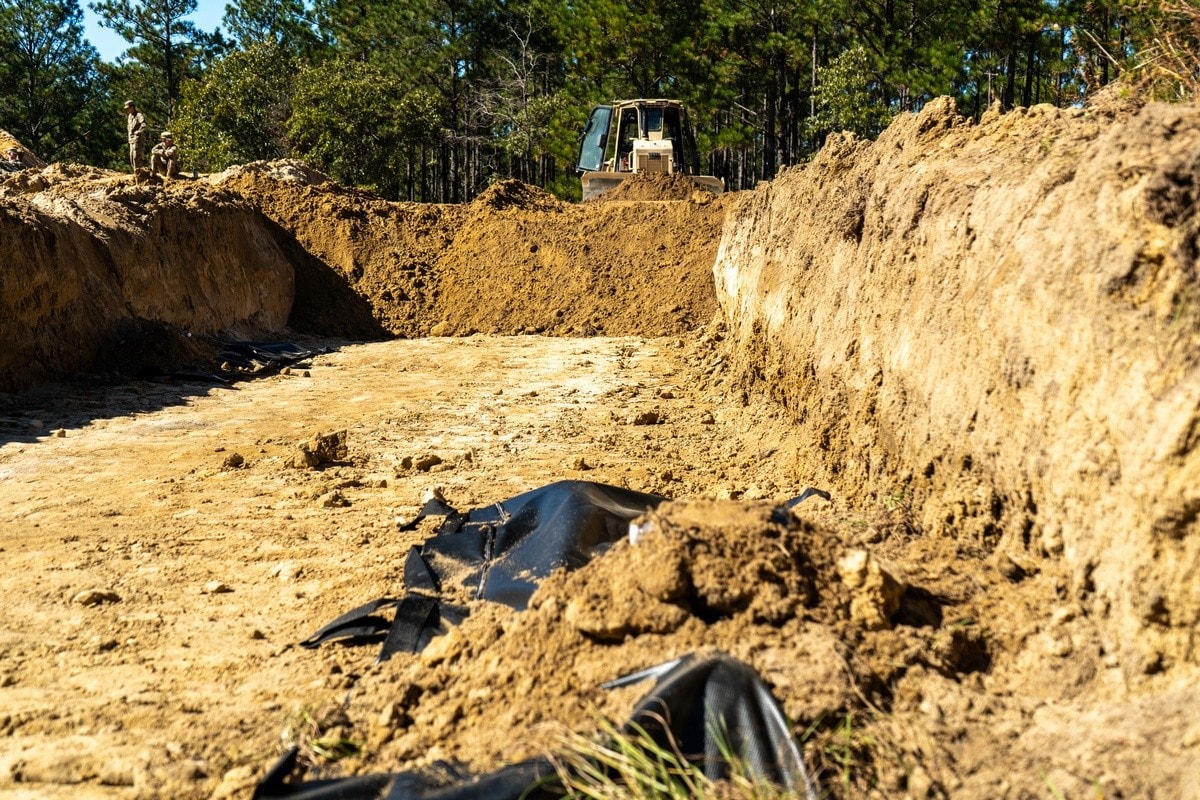
The core of the exercise, conducted near the St. Mere Eglise Drop Zone, evaluated whether heavy earthmoving equipment could excavate and backfill temporary plots rapidly without causing structural collapse or damage to remains.
Doctrinally, a standard temporary interment plot consists of five parallel trenches designed to hold 100 casualties - ten laid on each side of a trench. In previous exploratory trials, units attempted excavation using standard backhoes, averaging three hours per trench for only ten remains. During Dragon Covenant, operators from the 27th Engineer Battalion, 20th Engineer Brigade, utilized D6 bulldozers, completing a full 20-remains trench in an average time of one hour and 15 minutes.
During the dig, the team realized they needed to adjust from published spatial standards. Doctrine originally called for a seven-foot corridor between rows, which proved two feet too narrow for a dozer's tracks to navigate without disturbing the burial area.
“We realized quickly that the existing measurements in the book didn’t accommodate the physical reality of the equipment,” Ruede said. “To prevent running over the remains, we expanded the trench to a 15-foot width and maintained a nine-foot pillar of undisturbed soil between each trench. That undisturbed pillar allows the dozer to drive along the center corridor and cast dirt inward to backfill without exerting direct downward pressure on the remains.”
To evaluate the structural effect of backfilling on human remains, the team conducted controlled tests using simulated skeletal models and sealed water containers placed on the floor of the trench. Operators practiced keeping the dozer blade 18 inches off the ground, relying on the natural gravity fall of displaced soil rather than blade force. Subsequent exhumations verified that the water containers and models withstood the backfilling process without crushing, confirming that the remains would remain structurally intact for future forensic teams.
“Backfilling without desecrating the remains is where the real skill lies,” said 1st Lt. Connor Thompson, an engineer officer with the 27th Engineer Battalion. “Every operator has a different skill set, and soil conditions play a huge factor. Doing this in dry sand is completely different from frozen ground, clay, or mud. Getting our operators actual stick time on this specific task gives us data rather than assumptions.”
Based on the demonstrated one-hour-and-15-minute dig time, planners estimated that an engineer company equipped with eight bulldozers and four High Mobility Engineer Excavators (HMEEs) could prepare and close trenches for up to 2,400 remains every 24 hours during continuous operations.
Temporary Interment Religious Support Operations
While engineers developed mechanical tactics, the exercise provided unprecedented training for military chaplains and religious affairs specialists confronting mass-casualty environments. Hosted jointly by the 3rd CSC Unit Ministry Teams and the XVIII Airborne Corps Chaplain Section, the training brought together 130 religious support personnel representing units across the corps, including the 82nd Airborne Division, 101st Airborne Division (Air Assault), Fort Bragg Garrison, and Special Forces elements.
The exercise represented the first time in more than 20 years that Army chaplains and religious affairs personnel trained on religious support for temporary battlefield interment. For over two decades of counterinsurgency operations, fallen service members were routinely evacuated rapidly through established mortuary affairs channels to the continental United States.
During the training, UMTs identified a requirement for the development of temporary interment religious support standard operating procedures during LSCO to ensure every human remain is treated with dignity and honor before reaching their final resting place.
“Dragon Covenant was an opportunity to exercise religious support for fatality management operations from initial remains recovery to temporary interment,” said Chaplain (Lt. Col.) Ruska, chaplain for the 3rd CSC. “In a high-intensity, contested combat environment, fatality management teams cannot stop a 24-hour interment operation for individualized religious gravesite services. UMTs must advise commands on the most effective practice to integrate religious support for fatality management seamlessly without interrupting the flow of operations while honoring the fallen.”
Before the first engineer blades entered the earth, Chaplain (Maj.) Warwick Fuller, 20th Engineer Brigade chaplain, opened the interment site with an invocation to consecrate the grounds.
A vital takeaway from the exercise was the tactical integration of religious affairs specialists (MOS 56M). Master Sgt. Amelia Alston, 3rd CSC religious affairs noncommissioned officer, and Master Sgt. Lakesha Copeland, 82nd Airborne Division religious affairs NCO, led efforts to integrate and synchronize 56M enlisted personnel directly into the interment support workflow. As frontline assets within the Chaplain Corps, religious affairs specialists and NCOs proved essential in providing religious support capabilities, coordinating logistics, monitoring Soldier welfare, and ensuring dignity and respect of human remains.
“In an operational environment, we may not be able to identify the individual identities or faith backgrounds of the fallen Service Members,” Ruska said. “We consulted with Chaplains from various low density faith groups for advisement. The consensus was that by consecrating the site before remains are placed in the ground reassures families that their loved ones are treated with reverence, dignity and honor despite the inability to provide a memorial ceremony in a contested combat environment.”
After the notional human remains were placed in the ground, Chaplain (Maj.) Cornelius Muasa, 3rd CSC deputy command chaplain, and Chaplain (Capt.) David Chacko, the 330th Movement Control Battalion Chaplain and Fort Bragg Catholic Priest, offered committal prayers for the temporary interment of human remains as engineer equipment backfilled and closed the site.
The exercise also underscored the significant emotional, psychological, and spiritual toll that fatality management operations place on personnel, who historically experience some of the highest rates of operational stress. Doctrinal planning factors identified during Dragon Covenant indicate that UMTs supporting high-casualty operations could experience physical, emotional, and spiritual exhaustion within four to six hours. These findings highlight the need for deliberate UMT rotation plans across brigade and division echelons to sustain UMT readiness, preserve operational effectiveness, and ensure continuous religious support through prolonged fatality management operations.
Data, spatial dimensions, and after-action findings gathered during Operation Dragon Covenant are being forwarded directly to the Joint Mortuary Affairs Center, Fort Lee, Virginia, and the Chaplain Corps’ Transformation Integration Directorate.
The findings will directly refine the forthcoming revision of ATP 4-46 (Fatality Management) to ensure trench dimensions match modern engineer vehicle specifications, while informing future iterations of ATP 1-05.05 (Religious Support to Casualty Care) to codify temporary interment protocols for unit ministry teams.
The 3rd CSC plans to build on the lessons of Dragon Covenant by conducting Phase III next spring. The expanded exercise will look to stress-test the entire pipeline under both daytime and blackout conditions using night-vision systems, integrating security teams, Role 2 medical facilities and a fully staffed Mortuary Affairs Collection Point.
As the U.S. Army continues to prepare for the logistical complexities of large-scale combat operations, the procedures tested during Operation Dragon Covenant establish the foundational blueprints necessary to meet mission requirements while maintaining the military’s solemn pledge to honor its fallen service members.
Key Facts
- Official source: Army News
- Published: Oct 26, 5:54 AM EDT
- Text source: Army News official source page