
THE APEX TIMES
Wiesbaden Conducts Multi-Echelon MWD CASEVAC and K9TCCC Exercise
WIESBADEN, Germany - The Wiesbaden Veterinary Treatment Facility, an element of Veterinary Readiness Activity Rheinland-Pfalz, joined forces with the 52...
WIESBADEN, Germany - The Wiesbaden Veterinary Treatment Facility, an element of Veterinary Readiness Activity Rheinland-Pfalz, joined forces with the 525th Military Police Detachment, the Wiesbaden Army Health Clinic and host-nation partner security personnel for a comprehensive Canine Tactical Combat Casualty Care and casualty evacuation training exercise.
The multi-phase evolution paired hands-on flight line aeromedical operations with intensive point-of-injury medical lanes at Clay Gymnasium, stress-testing soldiers and canines under conditions replicating combat triage in forward operating environments.
For military working dogs, the chaotic noise, dynamic vibrations and rushing rotor wash of a rotary-wing aircraft can provoke extreme sensory overload. Acclimating the K9s to rotary-wing assets before they deploy downrange is critical to mission success.
Throughout the morning and early afternoon, tactical teams executed back-to-back UH-60 Blackhawk iterations. These consisted of cold and hot loads, local flight pattern familiarization, and a long-range tactical medical transfer between Wiesbaden and Veterinary Medical Center Europe. The working dog teams trained alongside their military and POND Security handlers to approach aircraft, board securely, maintain composure in-flight and rapidly disembark in a tactical posture.
According to Sgt. First Class Cory Wolfle, Kennel Master and Military Working Dog Handler, specialized veterinary care is rarely collocated with small tactical teams in forward operational environments, leaving combat medics and dog handlers to represent the critical first echelon of care.
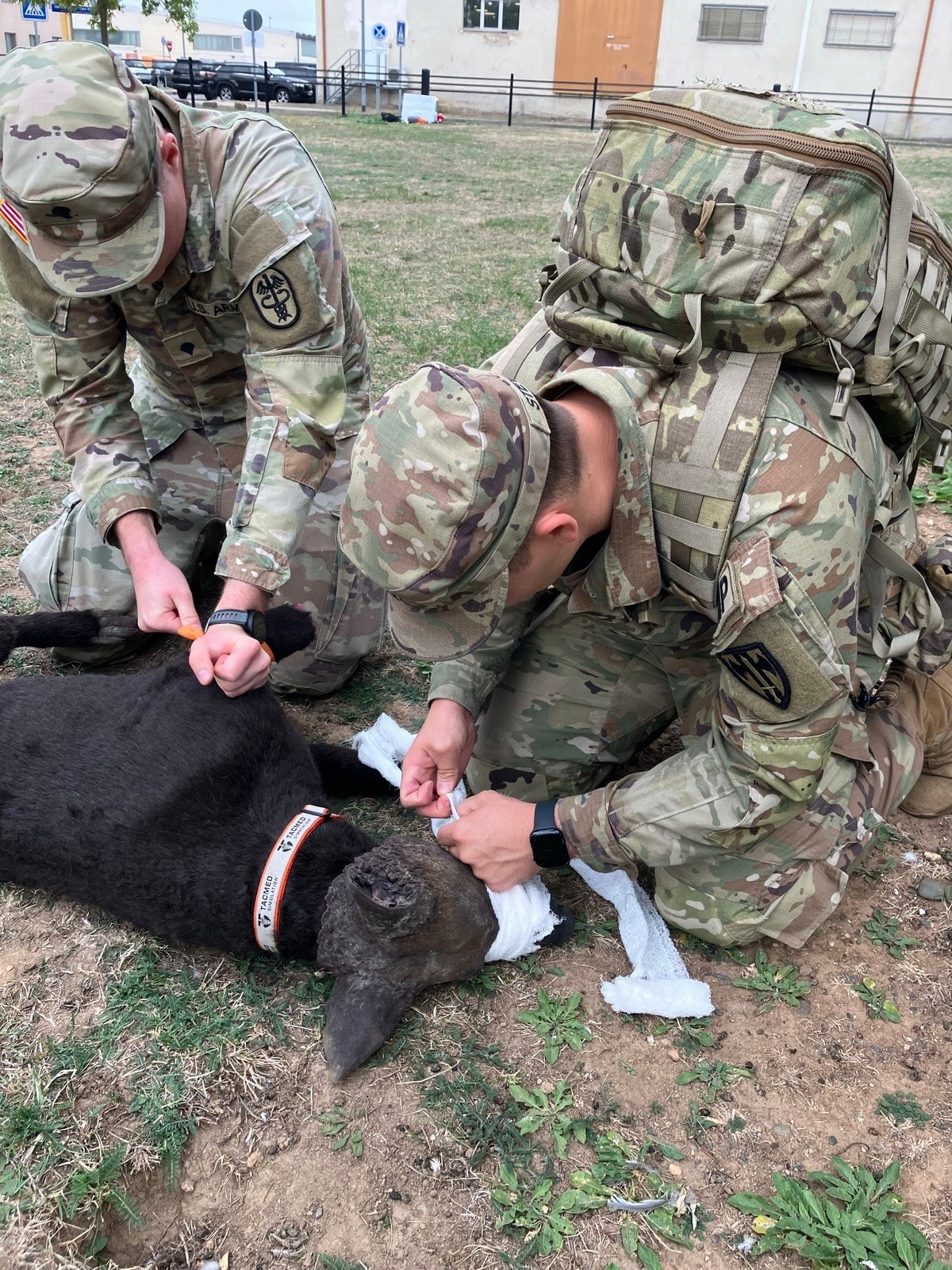
Parallel medical lanes subjected medical providers and handlers to complex trauma simulations using advanced "DIESEL" canine trauma simulators. These high-fidelity manikins realistically reproduce femoral pulses, arterial hemorrhage, thoracic chest wall trauma and obstructed airways.
Participants navigated the rigor of the M²ARCH² PAWS algorithm, which stands for Muzzle, Massive Hemorrhage, Airway, Respirations, Circulation, Hypothermia, Head trauma, followed by Pain, Antibiotics, Wounds and Splinting.
Capt. Amanda Zanger, veterinarian and officer in charge of the Wiesbaden Veterinary Treatment Facility, planned and coordinated the joint event to ensure theatrical readiness.
According to Zanger, VMCE represents the only Role 4 hospital on the continent. In the past, patients had to be transferred to Ramstein Air Base before moving to VMCE, but the newly established landing zone reduces patient transfer times by 80 percent.
The exercise also provided valuable interdisciplinary experience for the combat medics of the Wiesbaden Army Health Clinic. Human healthcare specialists accustomed to clinical settings and human anatomy successfully applied their core casualty management skills to treating working dogs.
From identifying canine airway anatomy to interpreting vital signs, where normal canine pulse rates can reach 100 beats per minute and respirations vary widely under heat and exertion, the cross-training significantly broadened unit capabilities across USAG Wiesbaden.
By the conclusion of the exercise, personnel had completed intensive iterations across both trauma lanes and live flight profiles, reinforcing the readiness of the military working dogs that safeguard tactical installations worldwide.
Key Facts
- Official source: Army News
- Published: Oct 26, 3:13 AM EDT
- Text source: Army News official source page